
Telecommunications
·Japan & Asia-Pacific·12 monthsAI Customer Service and Network Operations for a Telecommunications Company
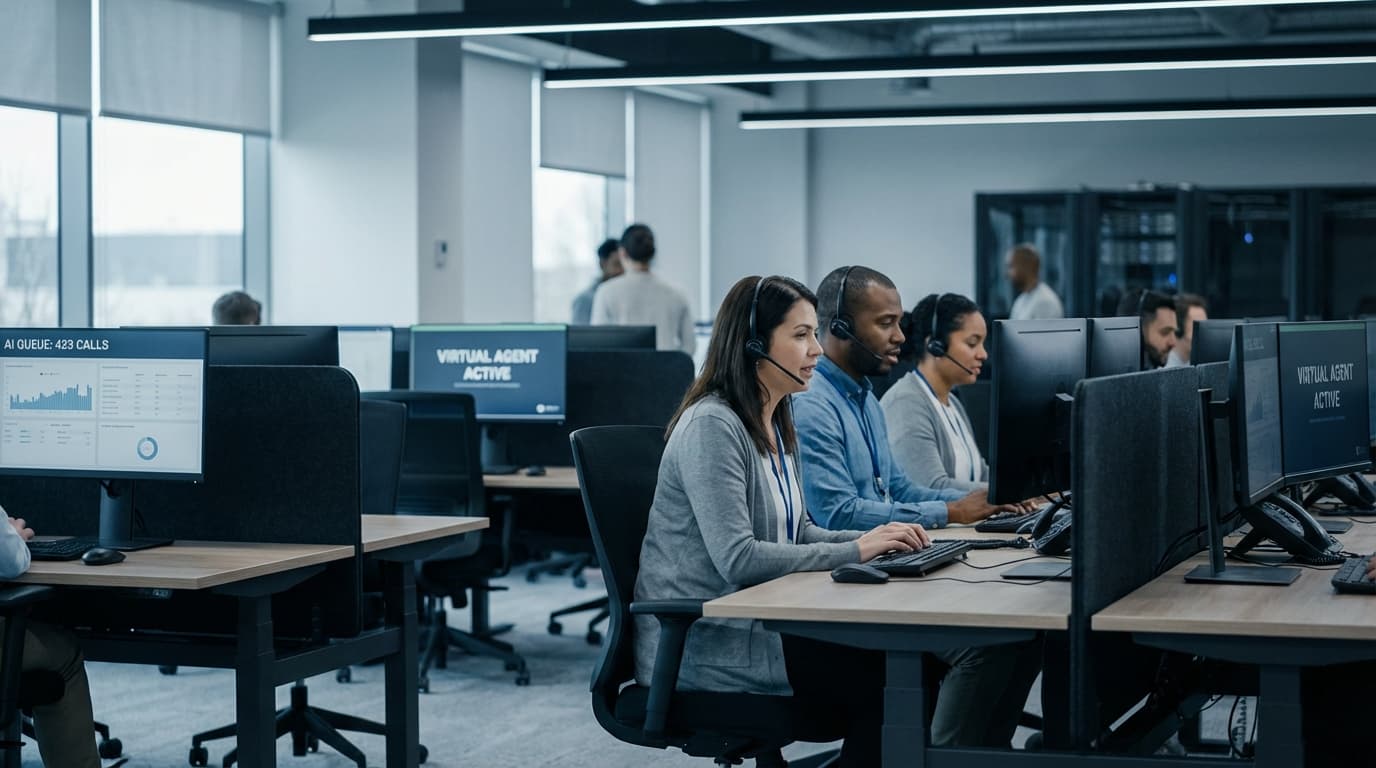
Deployed AI-powered customer service automation and network operations intelligence for a major telecommunications company. The system handles subscriber inquiries across voice and digital channels, automates service provisioning and fault resolution for common issues, and provides network operations teams with AI-driven incident correlation and root cause analysis.
65%
Digital inquiries resolved by AI
40%
Faster network root cause identification
Millions
Subscribers served across channels
Challenge
Telecommunications companies manage customer relationships at a scale that makes fully manual customer service economically unsustainable. This operator served millions of subscribers across mobile, broadband, and enterprise services, generating tens of thousands of customer contacts daily — billing inquiries, service activation requests, fault reports, plan changes, and technical support. The contact centre employed hundreds of agents, but call volumes consistently exceeded capacity during peak periods, driving long wait times, customer frustration, and high agent turnover. The nature of telecom customer issues varies enormously. Some are simple and repetitive ("What's my current bill?", "How do I change my plan?"), some require system interactions (activating a SIM, provisioning a service, processing a payment), and some require technical diagnosis ("My broadband is slow" — which could be a customer equipment issue, a local network fault, or a backbone capacity problem). The operator needed AI that could handle the simple issues autonomously, execute system transactions for service requests, and triage technical issues accurately before escalating to specialised support teams. Network operations presented a separate analytical challenge. The operator's network generated millions of alarm events daily from cell towers, switching equipment, transport links, and core infrastructure. The network operations centre (NOC) was overwhelmed by alarm volume — most alarms were symptoms of a smaller number of root cause issues, but identifying which alarms were related to the same underlying problem required experienced engineers who were in short supply. The average time to identify root cause for a major network incident was too long, extending the duration of service-impacting events.
Approach
Reluvate deployed a two-component system: customer service AI and network operations intelligence. The customer service module operates across the operator's digital channels (app chat, web chat, messaging platforms) and provides AI-assisted support for voice calls through real-time agent guidance. For digital channels, the AI handles subscriber inquiries autonomously — retrieving account information, explaining charges, processing plan changes, scheduling technician visits, and resolving common technical issues through guided troubleshooting. The system integrates with the operator's BSS (business support system) and OSS (operations support system) to execute transactions, not just provide information. For voice channels, the system provides real-time assistance to human agents: displaying relevant customer context, suggesting solutions based on the customer's issue and history, auto-populating transaction forms, and guiding agents through complex troubleshooting procedures. This hybrid approach preserves the human connection that many subscribers prefer for voice calls while significantly reducing average handle time. The network operations module ingests alarm data from across the network and applies correlation algorithms to group related alarms into incident clusters. For each incident cluster, the system identifies the most probable root cause by matching the alarm pattern against a knowledge base of known fault scenarios and their signatures. The recommended root cause is presented to NOC engineers with the evidence trail — which alarms correlate, why they point to the identified cause, and what resolution steps are recommended. For recurring fault patterns, the system triggers automated resolution procedures where possible.
Design Notes
The customer service AI was designed with the understanding that telecom subscriber issues often span multiple interactions. A customer who reported slow broadband yesterday and is calling today about the same issue expects the system to know the history. Reluvate built a conversation continuity layer that maintains context across channels and interactions, so the AI (and any human agent who takes over) has full visibility of the customer's issue history, previous troubleshooting steps attempted, and any open tickets. Change management for contact centre agents required careful framing. Agents correctly perceived that AI would reduce the volume of simple inquiries that were their primary workload. Reluvate and the operator's leadership positioned the transition as a move toward higher-value customer interactions — the complex, relationship-intensive contacts that AI couldn't handle and that agents found more professionally satisfying. Agents who developed skills in handling escalated cases, technical troubleshooting, and retention conversations found their roles elevated rather than eliminated. Exception handling in telecom customer service must account for the emotional dimension. Customers experiencing service outages or billing disputes are often frustrated, and an AI that responds to frustration with standard scripts escalates rather than resolves the situation. The system monitors conversation sentiment in real-time and triggers escalation to human agents when emotional signals (aggressive language, repeated frustration expressions, explicit requests for a human) are detected. The handoff includes full conversation context and a summary of the customer's emotional state, preparing the agent for a sensitive interaction.
Result
Digital channel inquiries are now handled predominantly by AI, reducing contact centre call volume and improving first-contact resolution rates. Average handle time for voice calls decreased through real-time agent assistance. Network incident root cause identification time decreased significantly, reducing the duration of service-impacting events. The operator achieved measurable improvements in customer satisfaction scores and net promoter score, attributed to faster resolution times and more consistent service quality across channels.
Related Case Studies
Retail
Autonomous Operations for a National Furniture Retailer
Deployed end-to-end autonomous operations across five business functions — HR, procurement, customer service, accounts, and marketing — for a national furniture retailer with multiple showrooms. This is Reluvate's longest and deepest client engagement, running continuously for over 2.5 years with expanding scope.
Events & Hospitality
AI Customer Engagement Platform for a National Events Company
Deployed a multi-channel AI chatbot for a national events company, handling attendee inquiries, event registration, vendor coordination, and post-event follow-up across WhatsApp, web chat, and social media channels. The system reduced customer service headcount requirements during peak event periods while improving response times from hours to seconds.
Insurance
AI Claims Processing Automation for a Regional Insurer
Long-running engagement automating insurance claims processing for a regional insurer. The system handles document extraction from claim submissions, automated adjudication for standard claims, fraud signal detection, and workflow orchestration for complex claims requiring human review. Weekly collaborative meetings have run continuously for over two years.