
Logistics & Warehousing
·Singapore & Malaysia·10 monthsAI-Powered Warehouse Operations and Delivery Routing for a Logistics Provider
Deployed AI-driven warehouse operations and delivery routing optimisation for a regional logistics provider managing multiple warehouse facilities and a fleet of delivery vehicles. The system automates inventory placement optimisation, pick-path routing, workforce scheduling, and last-mile delivery routing — transforming warehouse operations from experience-dependent manual processes to data-driven, continuously optimised workflows.
30%
Improvement in peak-period pick productivity
20%
Increase in on-time delivery rate
Dynamic
Real-time route re-optimisation
Challenge
Logistics providers face a dual optimisation challenge: maximising warehouse efficiency (getting products in and out of storage as fast as possible) and maximising delivery efficiency (getting products to customers via the shortest, cheapest routes). This provider operated multiple warehouse facilities in Singapore and Malaysia, serving e-commerce retailers, FMCG distributors, and industrial clients with different service level requirements — same-day delivery for e-commerce, scheduled delivery windows for B2B, and just-in-time delivery for manufacturing clients. Warehouse operations were managed by experienced supervisors who made minute-by-minute decisions about task allocation, pick sequencing, and staging based on their knowledge of the facility layout, product locations, and team capabilities. This experience-dependent model worked at moderate volumes but broke down during peak periods (campaign sales, holiday seasons) when temporary workers unfamiliar with the facilities were brought in. Pick accuracy dropped, throughput decreased, and the facilities struggled to meet service level commitments. Delivery routing was planned each morning based on the day's order set, with drivers receiving fixed routes. Mid-day changes — new orders, cancellations, traffic disruptions, vehicle breakdowns — required manual re-routing by dispatchers who couldn't process the full optimisation in the available time. Late deliveries during peak periods were common, damaging client relationships and incurring penalty charges. The provider's management knew that better routing could improve both delivery performance and fleet utilisation, but the mathematical complexity of multi-vehicle, multi-constraint routing exceeded their planning team's analytical capacity. Order forecasting was non-existent — the provider learned about each day's volume when orders arrived, leaving no time for proactive resource planning. Staffing was based on historical averages with ad-hoc adjustments, resulting in overstaffing on quiet days and understaffing on busy days.
Approach
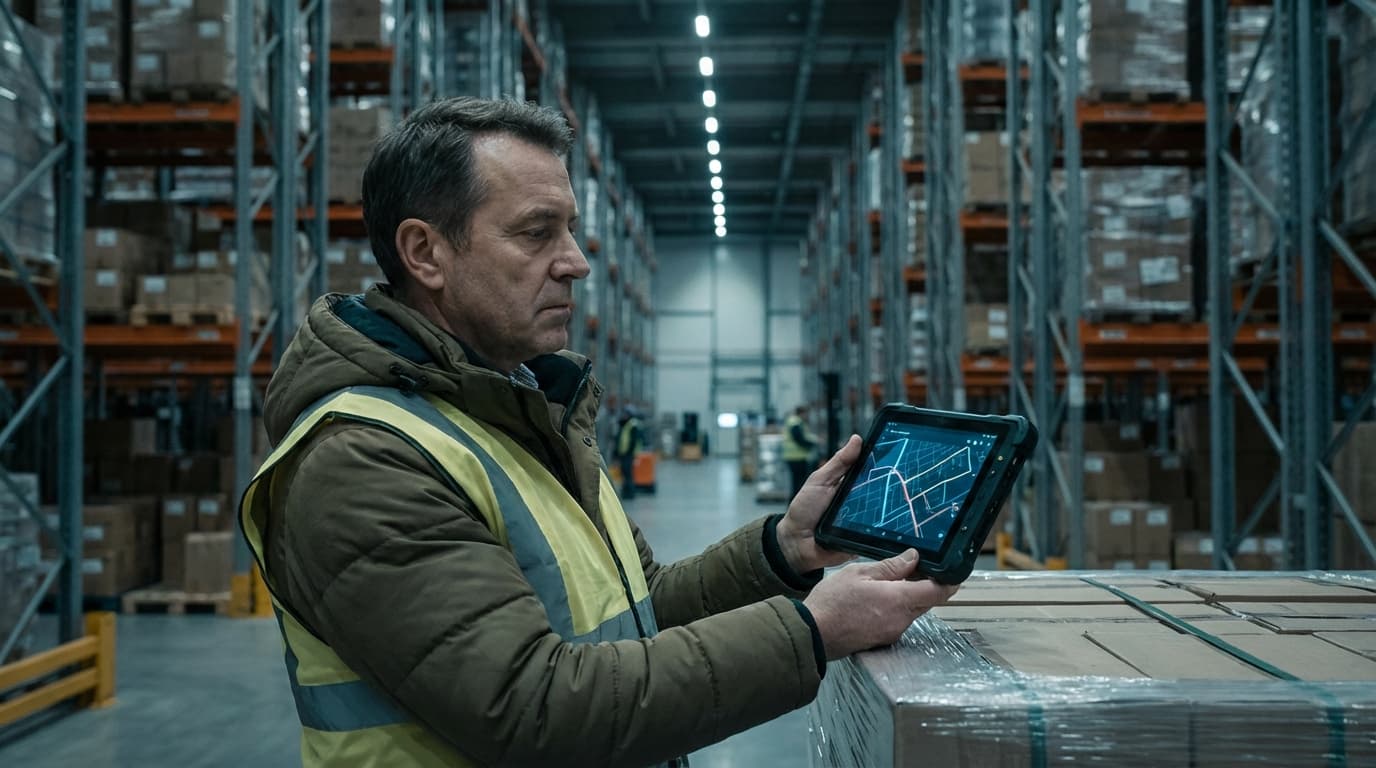
Reluvate deployed an integrated warehouse and delivery optimisation platform. The warehouse module begins with inventory placement optimisation — using order frequency analysis to position fast-moving SKUs in locations that minimise pick travel distance, staging frequently co-ordered products in proximity, and reserving premium locations for items in active promotions. The placement model is continuously updated as order patterns shift. Pick-path optimisation generates efficient routes through the warehouse for each pick wave, sequencing picks to minimise travel distance while respecting constraints (heavy items first for pallet stability, temperature-sensitive items last for cold chain compliance). For temporary workers, the system provides turn-by-turn navigation on handheld devices — eliminating the learning curve that degraded productivity during peak periods. Workforce scheduling uses demand forecasts to determine staffing requirements by shift and function (receiving, putaway, picking, packing, staging), generating schedules that match labour supply to expected demand. The delivery routing module generates optimised routes for the entire fleet, considering vehicle capacity, delivery time windows, traffic patterns (using historical and real-time data), driver hours-of-service limits, and vehicle-specific constraints (refrigerated trucks for cold chain, specific vehicle sizes for access-restricted locations). Critically, the system supports dynamic re-routing throughout the day — when new orders arrive, deliveries are cancelled, or traffic disruptions occur, routes are recalculated and updated to drivers in real-time. Demand forecasting models predict next-day and next-week order volumes by client and product category, enabling proactive resource planning.
Design Notes
The pick-path optimisation was designed around the reality that perfect optimal paths are less valuable than good-enough paths delivered instantly. Computing the mathematically optimal pick sequence for a large order set is computationally expensive and yields diminishing returns beyond a good heuristic solution. Reluvate implemented a hybrid approach: a fast heuristic that generates near-optimal paths in milliseconds for real-time picking, combined with an offline optimiser that analyses historical pick data to improve the heuristic's performance over time. The practical result is that pickers receive an efficient path immediately, and the path quality improves continuously. Change management for warehouse supervisors required acknowledging their expertise while demonstrating the system's value. Supervisors knew their facilities intimately and made good decisions most of the time. But they couldn't simultaneously optimise across all active pickers, and their effectiveness dropped during peak periods when the number of concurrent decisions exceeded human cognitive capacity. Reluvate demonstrated the system by running it in parallel during a peak period, showing side-by-side comparisons of AI-optimised and supervisor-directed throughput. The throughput difference during peak — where the AI maintained performance that degraded under manual management — was convincing. Exception handling in logistics must be robust and fast. Vehicle breakdowns, driver absences, warehouse equipment failures, and client order changes all require immediate re-planning. The system maintains a real-time model of all resources — vehicles, drivers, warehouse workers, equipment — and can re-optimise affected plans within seconds of an exception event. For critical exceptions (major vehicle breakdown leaving time-sensitive deliveries unassigned), the system generates multiple alternative scenarios for the dispatcher to choose from rather than making an autonomous decision.
Result
Warehouse pick productivity improved through optimised paths and inventory placement, with particular improvement during peak periods when temporary worker efficiency was elevated by system guidance. Delivery on-time performance improved through better routing and dynamic re-planning capability. Fleet utilisation increased as optimised routing reduced empty miles and increased drops per route. Labour cost efficiency improved through demand-driven workforce scheduling that reduced both overstaffing and overtime. Client satisfaction scores improved as delivery reliability increased.
Related Case Studies
Retail
Autonomous Operations for a National Furniture Retailer
Deployed end-to-end autonomous operations across five business functions — HR, procurement, customer service, accounts, and marketing — for a national furniture retailer with multiple showrooms. This is Reluvate's longest and deepest client engagement, running continuously for over 2.5 years with expanding scope.
Events & Hospitality
AI Customer Engagement Platform for a National Events Company
Deployed a multi-channel AI chatbot for a national events company, handling attendee inquiries, event registration, vendor coordination, and post-event follow-up across WhatsApp, web chat, and social media channels. The system reduced customer service headcount requirements during peak event periods while improving response times from hours to seconds.
Insurance
AI Claims Processing Automation for a Regional Insurer
Long-running engagement automating insurance claims processing for a regional insurer. The system handles document extraction from claim submissions, automated adjudication for standard claims, fraud signal detection, and workflow orchestration for complex claims requiring human review. Weekly collaborative meetings have run continuously for over two years.