
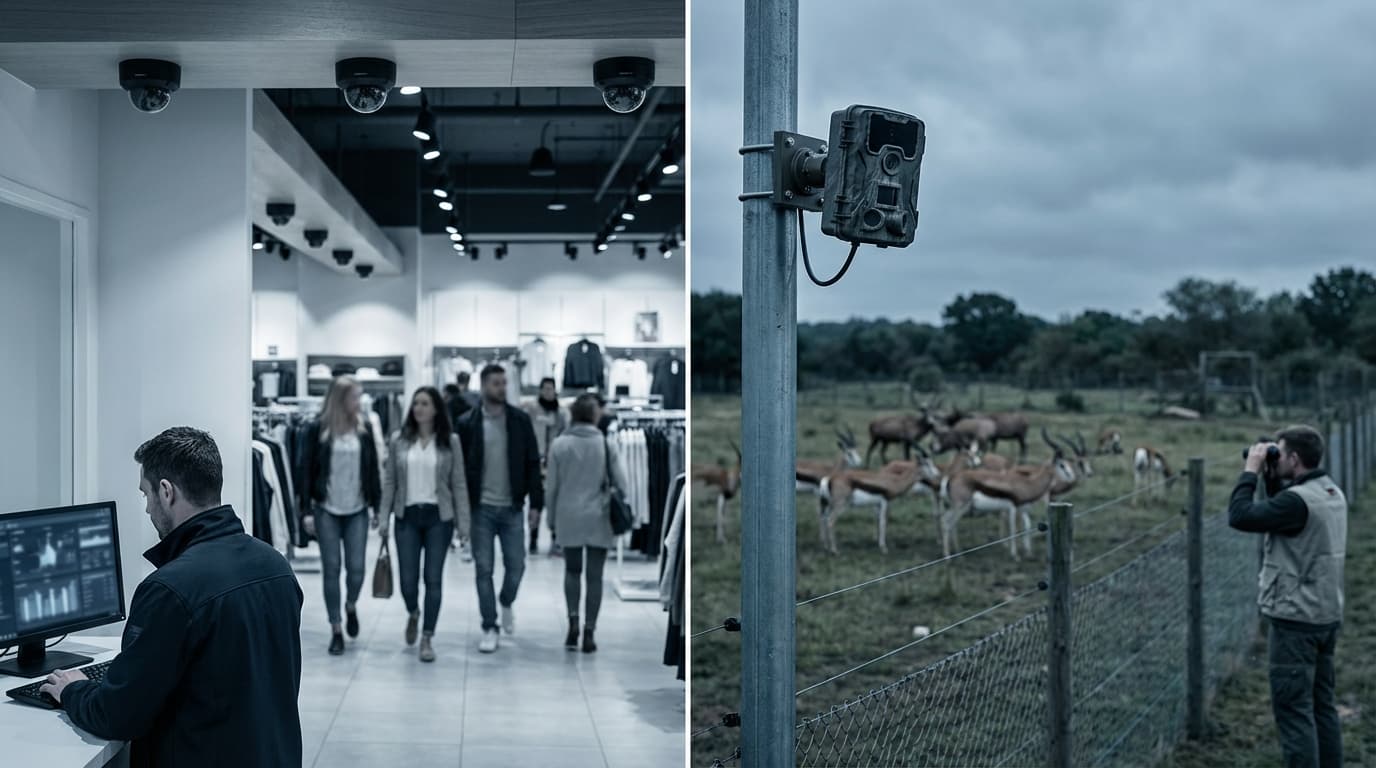
Retail & Conservation
·Asia-Pacific·12 monthsComputer Vision Retail Analytics and Wildlife Monitoring
Developed computer vision systems for two distinct domains: retail analytics (footfall tracking, customer heatmaps, and employee activity monitoring across store networks) and animal welfare monitoring (behavioural analysis, temperature tracking, and health anomaly detection). The retail system outperformed a major Chinese AI competitor's solution in accuracy benchmarks.
Beat
Major AI competitor in accuracy
24/7
Continuous monitoring capability
Real-time
Footfall and heatmap analytics
Challenge
Retail analytics in physical stores has been an unsolved problem for most retailers. E-commerce companies have rich data on every customer interaction — page views, click paths, time spent, cart abandonment — but physical retailers know almost nothing about what happens between a customer entering and leaving the store. Footfall counters give entry/exit numbers but no information about where customers go, what they look at, how long they browse, or how staff interactions affect purchase behaviour. This data asymmetry means that physical retail marketing and store layout decisions are made largely on intuition. The retailer had evaluated solutions from major vendors, including a well-funded Chinese AI company valued at over $40 billion, but found their accuracy insufficient for actionable analytics. Off-the-shelf solutions produced footfall counts with significant error rates, heatmaps that couldn't distinguish between staff and customers, and no ability to correlate foot traffic with sales data. The retailer needed a system accurate enough to make real operational decisions from — staffing schedules based on traffic patterns, layout changes based on browsing behaviour, campaign effectiveness measured through foot traffic changes. Separately, Reluvate was engaged to apply similar computer vision capabilities to animal welfare monitoring for a conservation context. The challenge here was detecting subtle behavioural changes — feeding patterns, movement frequency, social interactions, temperature anomalies — that might indicate health issues in monitored animals. The detection needed to be continuous (24/7 monitoring) and robust to environmental variability (lighting changes, weather, occlusion).
Approach
For retail analytics, Reluvate built a custom computer vision pipeline optimised for the specific challenges of in-store environments: variable lighting, occlusion from shelving and displays, and the need to distinguish staff from customers. The system uses overhead and angled camera feeds to generate real-time footfall counts, customer journey maps, zone-level dwell time analytics, and staff-customer interaction detection. The core tracking model was trained on in-store footage from the client's actual locations, not generic datasets, which was the primary reason it outperformed the competitor's general-purpose solution. Heatmap generation goes beyond simple presence detection. The system tracks individual customer journeys through the store, mapping their path from entry to exit with dwell time at each zone. Aggregated across thousands of visits, these journey maps reveal traffic patterns, dead zones, bottleneck areas, and the effectiveness of product placement and promotional displays. The analytics dashboard correlates foot traffic data with POS transaction data, enabling the retailer to measure conversion rates by zone and time period. For animal welfare monitoring, Reluvate adapted the tracking pipeline to detect species-specific behavioural patterns. The system monitors feeding frequency and duration, movement patterns and activity levels, social proximity and interaction, and body temperature through thermal camera integration. Baseline behavioural profiles are established for each monitored animal, and the system generates alerts when an individual's behaviour deviates significantly from its baseline — a potential early indicator of illness or distress.
Design Notes
The retail system was designed to work with the store's existing camera infrastructure wherever possible, avoiding the cost and disruption of a full camera installation. Reluvate conducted a camera audit at each location, identified which existing cameras had sufficient resolution and field of view for analytics, and recommended targeted additions only where gaps existed. The processing pipeline runs on edge devices installed at each store, with aggregated analytics sent to a central dashboard — this avoids the bandwidth costs and latency of streaming all video to the cloud. For change management in the retail context, privacy was the primary concern. The system was designed with privacy-by-design principles: no facial recognition, no individual identification, no footage retention beyond the processing window. All analytics are based on anonymised trajectory data. Reluvate worked with the retailer's legal team to ensure compliance with Singapore's PDPA and prepared documentation for display in stores informing customers of the analytics system. Exception handling in the wildlife monitoring context is particularly critical because a missed alert could have animal welfare implications. The system operates on a high-sensitivity, lower-specificity configuration — it would rather generate a false positive alert that a keeper investigates and dismisses than miss a genuine health concern. Alert fatigue is managed through a tiered system: routine deviations generate log entries, moderate deviations generate notifications, and significant deviations generate immediate alerts. The thresholds are calibrated per species and per individual animal based on their established behavioural baseline.
Result
The retail analytics system outperformed the competitor's solution in accuracy benchmarks conducted by the client, achieving significantly higher accuracy in footfall counting and customer-staff differentiation. The retailer now makes data-driven decisions about store layout, staffing schedules, and marketing campaign effectiveness based on actual customer behaviour data. The animal welfare monitoring system has been deployed for continuous 24/7 monitoring, enabling early detection of health concerns that would previously have been caught only during periodic manual checks.
Related Case Studies
Retail
Autonomous Operations for a National Furniture Retailer
Deployed end-to-end autonomous operations across five business functions — HR, procurement, customer service, accounts, and marketing — for a national furniture retailer with multiple showrooms. This is Reluvate's longest and deepest client engagement, running continuously for over 2.5 years with expanding scope.
Education
Award-Winning AI-Powered CAD Assessment for National Education
Developed an AI-powered automated assessment system for Computer-Aided Design (CAD) student submissions, replacing hours of manual instructor evaluation with instant, educational feedback. The system won the Ministry of Education (MOE) Innergy Award (Gold) — national recognition for innovation in education — and has been adopted internationally.
Events & Hospitality
AI Customer Engagement Platform for a National Events Company
Deployed a multi-channel AI chatbot for a national events company, handling attendee inquiries, event registration, vendor coordination, and post-event follow-up across WhatsApp, web chat, and social media channels. The system reduced customer service headcount requirements during peak event periods while improving response times from hours to seconds.