
Conservation & Animal Welfare
·Asia-Pacific·10 months (ongoing)AI Animal Welfare Monitoring for Zoological and Conservation Facilities
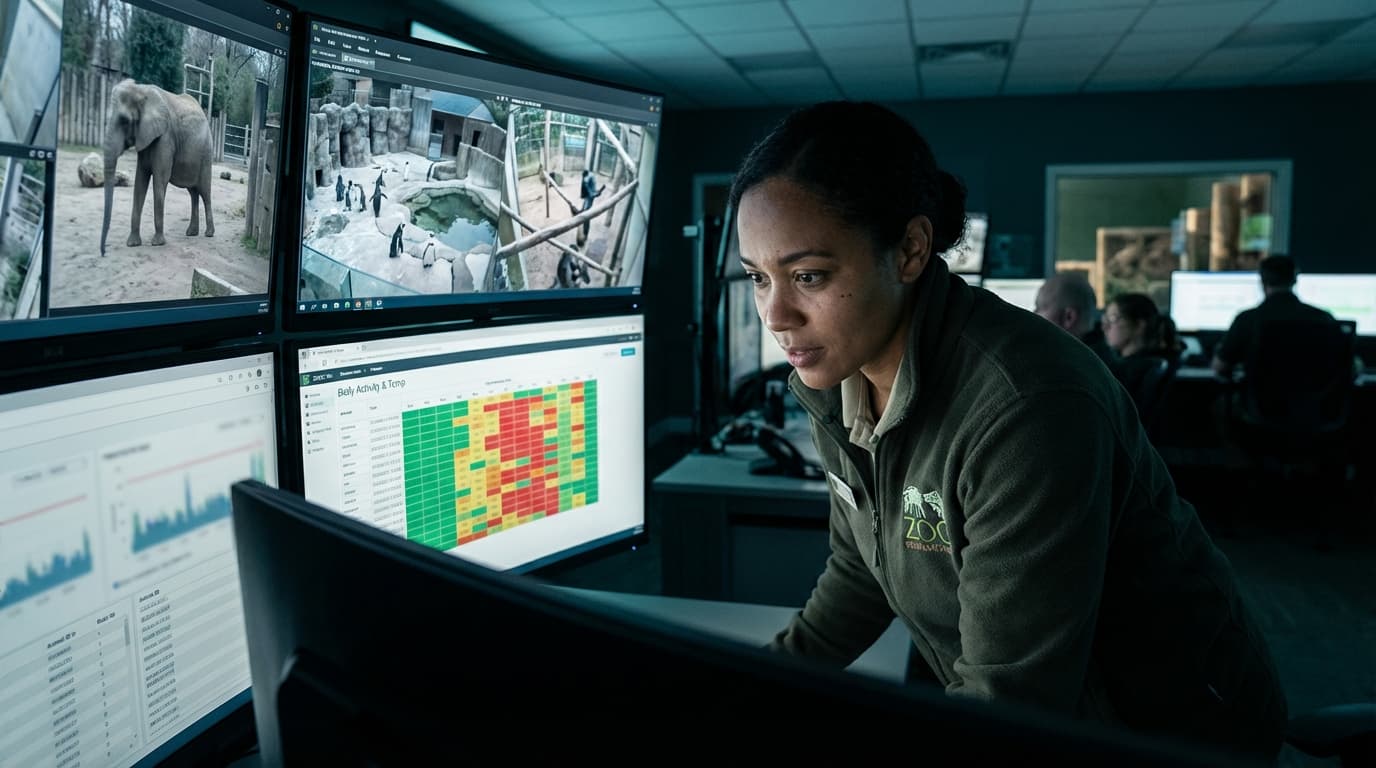
Deployed a computer vision system for continuous animal welfare monitoring across zoological and conservation facilities. The system analyses video feeds to track individual animal behaviour patterns, detect health anomalies, and generate welfare assessments — enabling 24/7 monitoring that supplements periodic keeper observations with continuous, objective, data-driven welfare intelligence.
24/7
Continuous welfare monitoring
Non-invasive
No handling or tagging required
Individual
Animal identification and tracking
Challenge
Animal welfare assessment in zoological facilities relies primarily on keeper observations — trained staff who know individual animals and can detect changes in behaviour, appetite, social interaction, and physical condition. But keeper observations are inherently limited: staff work in shifts, each keeper monitors multiple animals, and observations are concentrated during active management periods (feeding, enrichment, veterinary checks). The hours between observations — including overnight periods — represent monitoring gaps where welfare-relevant events may occur undetected. For endangered species in conservation breeding programmes, welfare monitoring has additional significance. Stress, illness, and behavioural abnormalities in breeding animals can affect reproductive success, and early detection enables interventions that may save breeding opportunities that are critical for species survival. Traditional monitoring approaches — periodic observation checklists, weight tracking, veterinary examinations — provide data points but not the continuous behavioural baseline needed to detect subtle changes early. The facilities had existing CCTV systems for security, but the footage was monitored reactively (reviewed after an incident) rather than proactively analysed for welfare indicators. The volume of footage — hundreds of cameras operating 24/7 — made manual review impractical. What was needed was an automated system that could process continuous video feeds and extract welfare-relevant behavioural metrics without requiring animal handling, physical sensors, or changes to the animals' environment.
Approach
Reluvate deployed a non-invasive monitoring system that processes existing CCTV feeds using computer vision. The system identifies individual animals using visual features (coat patterns, markings, body shape) and tracks their movement, posture, and activity throughout the day. For each monitored species, Reluvate developed species-specific behavioural models that define the expected range of normal behaviour — activity levels by time of day, feeding duration and frequency, social proximity patterns, resting posture, and enclosure space utilisation. The welfare assessment engine compares each animal's observed behaviour against its established baseline and against the species-typical range. Deviations are classified by type and severity: reduced activity (potential illness, pain, or depression), altered feeding behaviour (dental issues, GI problems, social stress), abnormal repetitive movements (stereotypic behaviour indicating welfare compromise), social isolation or aggression changes (social stress, hierarchical disruption), and postural changes (musculoskeletal issues, abdominal pain). Each detected deviation generates an alert with the specific behavioural change observed, the degree of deviation from baseline, and a suggested welfare assessment protocol. Thermal imaging integration adds a physiological dimension. Thermal cameras detect body surface temperature patterns that can indicate inflammation, infection, or stress. The system monitors thermal profiles over time, detecting temperature anomalies that may precede clinically apparent illness. For species where thermal patterns are diagnostically useful (particularly birds and reptiles where behavioural signs of illness are subtle), thermal monitoring provides an early warning layer that complements behavioural analysis.
Design Notes
The individual identification system was designed to work without any physical tagging or marking of animals — a non-negotiable requirement for conservation facilities where any handling stress must be minimised. For species with distinct visual patterns (giraffes, zebras, big cats), Reluvate trained re-identification models on the facility's existing photograph databases. For species with less distinctive visual features, the system uses a combination of body proportions, gait analysis, and learned spatial preferences (individual animals tend to have preferred resting spots) to maintain identity tracking. Change management with keeper teams was approached as a partnership. Keepers have deep knowledge of individual animals that no AI system can replicate — they know an animal's personality, its history, its idiosyncratic behaviours. Reluvate designed the system to augment this knowledge with continuous quantitative data. During the calibration phase, keepers annotated the AI's behavioural classifications, correcting misinterpretations and adding context that improved the models. The result is a system that keepers trust because they helped build it. Exception handling prioritises animal safety above all other considerations. The system operates on a high-sensitivity configuration — it would rather generate a false alert that a keeper investigates and dismisses than miss a genuine welfare concern. For species with known vulnerability to specific conditions (e.g., respiratory infections in primates, foot problems in elephants), the system applies species-specific alert thresholds that trigger at lower deviation levels than the general model. Emergency alerts — detected collapse, prolonged immobility, acute behavioural distress — bypass the normal notification workflow and generate immediate alerts to on-duty veterinary staff.
Result
Continuous 24/7 monitoring has filled the observation gaps inherent in shift-based keeper coverage. Multiple welfare-relevant events have been detected during overnight periods that would previously have gone unnoticed until the next morning's keeper check. Longitudinal behavioural data provides veterinary teams with objective, quantitative welfare assessments that complement clinical examination findings. The system has been particularly valuable for conservation breeding programmes, where behavioural indicators of reproductive readiness and stress can inform breeding management decisions.
Related Case Studies
Education
Award-Winning AI-Powered CAD Assessment for National Education
Developed an AI-powered automated assessment system for Computer-Aided Design (CAD) student submissions, replacing hours of manual instructor evaluation with instant, educational feedback. The system won the Ministry of Education (MOE) Innergy Award (Gold) — national recognition for innovation in education — and has been adopted internationally.
Conservation & Non-Profit
AI-Driven Finance Automation for an International Conservation Organisation
Long-term partnership deploying AI-driven finance automation for a major international conservation organisation. The engagement covers budget management, ROI modelling, lifetime value calculations, and donor compliance reporting — enabling the organisation to redirect staff from administrative work to conservation mission delivery.
Retail & Conservation
Computer Vision Retail Analytics and Wildlife Monitoring
Developed computer vision systems for two distinct domains: retail analytics (footfall tracking, customer heatmaps, and employee activity monitoring across store networks) and animal welfare monitoring (behavioural analysis, temperature tracking, and health anomaly detection). The retail system outperformed a major Chinese AI competitor's solution in accuracy benchmarks.