
Education & Sports Science
·Singapore·12 months (ongoing)AI Movement Assessment for Early Childhood Athletic Development
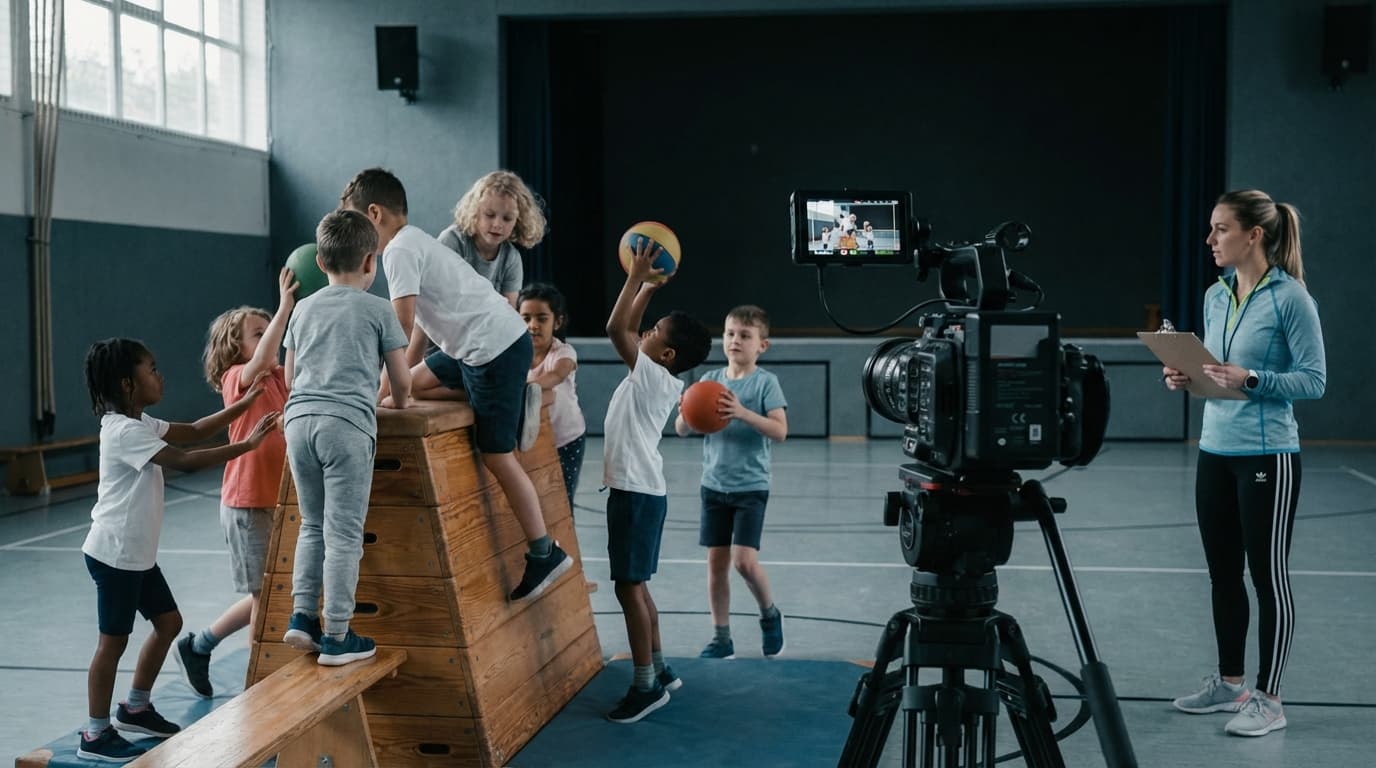
Developed a mobile-based AI system that assesses Fundamental Movement Skills (FMS) in young children using computer vision, replacing manual coach observation with automated, objective measurement. The system captures video of children performing movement tasks, analyses biomechanical patterns, and generates developmental assessments that inform coaching programmes — enabling scalable identification and nurturing of athletic potential from early childhood.
Thousands
Children assessed at scale
Mobile
Smartphone-based assessment (no lab required)
Longitudinal
Developmental tracking over years
Challenge
Fundamental Movement Skills — running, jumping, throwing, catching, balancing, kicking — form the foundation for all athletic development. Research consistently shows that children who develop proficient FMS by age 7-8 are significantly more likely to remain physically active and develop sport-specific skills. Early identification and targeted coaching of FMS deficiencies can dramatically alter a child's athletic trajectory. Yet FMS assessment in early childhood settings is almost entirely manual: trained coaches observe children performing movement tasks and score them against developmental rubrics. The manual approach has three fundamental limitations. First, it doesn't scale — a trained assessor can evaluate perhaps 15-20 children per hour, making population-level screening prohibitively expensive. Second, it's subjective — different assessors score the same movement differently, and even the same assessor's scores vary with fatigue and attention. Third, it provides only point-in-time snapshots — tracking a child's movement development over months and years requires repeated assessments that are logistically difficult to arrange. The national education body wanted to integrate FMS assessment into early childhood education programmes at scale — reaching tens of thousands of children annually. The only feasible approach was automated assessment that could be conducted by early childhood educators (not trained sports scientists) using commonly available equipment (smartphones and tablets, not motion capture studios).
Approach
Reluvate developed a mobile application that guides educators through a structured FMS assessment protocol. For each movement skill, the app presents the assessment task, instructs the educator on camera positioning, and records video of the child performing the movement. Computer vision models process the video to extract biomechanical features: joint angles, movement timing, body segment coordination, balance metrics, and movement quality indicators. The assessment engine evaluates extracted biomechanical features against age-normed developmental rubrics. For each FMS, the system scores the child's proficiency on a developmental scale, identifies specific movement components that are below expected development, and generates coaching recommendations targeting the identified deficiencies. The recommendations are written for early childhood educators, not sports scientists — practical activities and games that develop specific movement capabilities within a typical preschool environment. Longitudinal tracking is a core feature. Each child's FMS profile is maintained over time, showing developmental progression across all measured skills. The system generates cohort-level analytics for programme administrators — identifying which movement skills are most commonly underdeveloped in a population, whether coaching interventions are producing measurable improvement, and how cohorts compare against national norms. This population-level intelligence informs curriculum development and resource allocation for national physical literacy programmes.
Design Notes
The computer vision pipeline was designed for the constraints of early childhood assessment. Young children don't perform movements on command in controlled environments — they squirm, get distracted, start and stop, and rarely produce the clean, repeatable movements that adult biomechanical analysis assumes. Reluvate trained the pose estimation models on a dataset of actual young children performing FMS tasks, capturing the variability and imprecision inherent in early childhood movement. The system automatically identifies the best movement attempt from a video clip, filtering out false starts, distractions, and incomplete attempts. Change management addressed early childhood educators' understandable concern about introducing assessment technology into play-based learning environments. Reluvate worked with education specialists to design the assessment protocol as a series of fun movement games rather than formal tests. The app presents assessment tasks as activities that children enjoy — obstacle courses, ball games, balance challenges — so the assessment experience is indistinguishable from normal physical play. Educators reported that children looked forward to 'assessment days' because the activities were engaging. Exception handling accounts for the developmental variability in young children. A child having a bad day, feeling unwell, or simply being uninterested can produce assessment results that don't reflect their actual capability. The system flags assessments where the child's engagement appeared low (based on movement frequency and completion patterns) and recommends reassessment. Individual results that deviate significantly from the child's historical profile are also flagged rather than recorded as definitive, preventing a single poor performance from distorting the developmental record.
Result
The FMS assessment system enables population-scale screening that was previously impractical. Thousands of children have been assessed using the mobile application, generating the first large-scale dataset of FMS development in the target age group. Coaching recommendations have been integrated into early childhood education programmes, with longitudinal data showing measurable improvement in targeted movement skills. The system has been adopted by the national education body as a standard assessment tool for early childhood physical literacy.
Related Case Studies
Education
Award-Winning AI-Powered CAD Assessment for National Education
Developed an AI-powered automated assessment system for Computer-Aided Design (CAD) student submissions, replacing hours of manual instructor evaluation with instant, educational feedback. The system won the Ministry of Education (MOE) Innergy Award (Gold) — national recognition for innovation in education — and has been adopted internationally.
Retail & Conservation
Computer Vision Retail Analytics and Wildlife Monitoring
Developed computer vision systems for two distinct domains: retail analytics (footfall tracking, customer heatmaps, and employee activity monitoring across store networks) and animal welfare monitoring (behavioural analysis, temperature tracking, and health anomaly detection). The retail system outperformed a major Chinese AI competitor's solution in accuracy benchmarks.
Education Technology
AI-Powered Talent Management Platform for an EdTech Company
Built an AI-driven talent management platform that maps employee competencies against job requirements, generates personalised training roadmaps, and automates assessment through AI-generated questions and essay marking. The platform enables organisations to identify skill gaps, track development progress, and make data-driven decisions about talent deployment.