
Public Transport
·Singapore·14 months (ongoing)AI Predictive Maintenance and Passenger Analytics for a Public Transport Operator
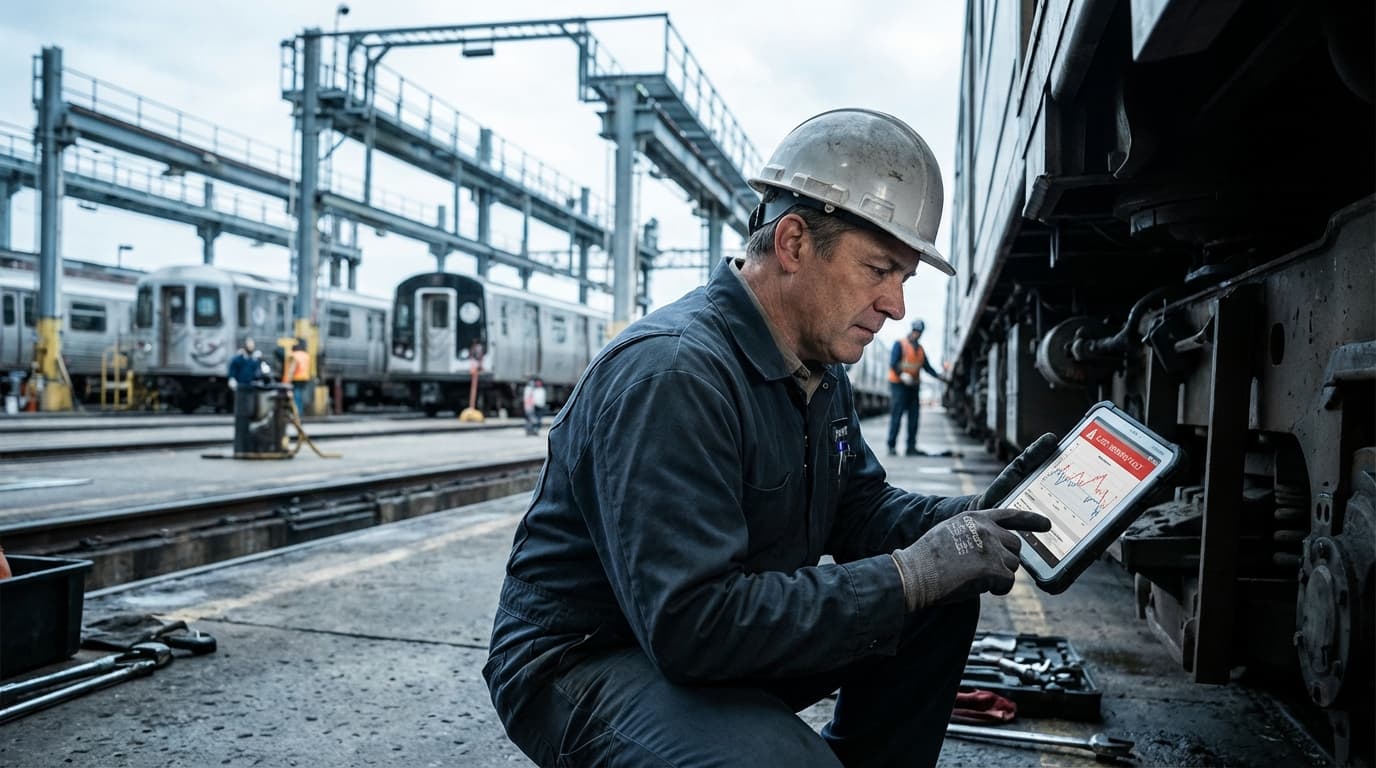
Deployed AI-driven predictive maintenance and passenger flow analytics for a major public transport operator managing rail and bus networks. The system analyses equipment telemetry to predict failures before they cause service disruptions, optimises maintenance scheduling, and provides passenger flow intelligence to improve service planning and crowd management.
30%
Reduction in unplanned failures
Millions
Daily passenger trips analysed
Condition-based
Maintenance replacing fixed schedules
Challenge
Public transport operators face an unforgiving operational reality: service disruptions are immediately visible to millions of commuters and amplified by social media and political scrutiny. This operator managed an extensive rail and bus network serving millions of daily trips, with a fleet of thousands of vehicles and tens of thousands of equipment assets — train doors, escalators, air conditioning units, signalling systems, track components, and bus engines. Maintenance was predominantly schedule-based: equipment was serviced at fixed intervals regardless of actual condition, leading to both under-maintenance (failures between scheduled services) and over-maintenance (replacing components with significant remaining useful life). Unplanned failures were the operator's most expensive problem. A train door failure could delay a service, cascading into network-wide disruptions during peak hours. An escalator breakdown at a busy interchange created crowd management issues. Each incident triggered not just direct repair costs but indirect costs: service recovery expenses, passenger compensation, and reputational damage. The operator's engineering team knew that transitioning to condition-based maintenance could reduce failures, but the volume and diversity of equipment telemetry data — vibration sensors, temperature readings, current measurements, door cycle counts, operational logs — exceeded their capacity to analyse manually. Passenger flow management was another challenge. The operator had basic ridership data from fare card taps, but lacked the analytical capability to translate this data into actionable intelligence for service planning. Understanding how passengers moved through the network — transfer patterns, platform crowding dynamics, peak-within-peak surges — required analysis beyond what the planning team could perform with spreadsheet tools.
Approach
Reluvate deployed a predictive maintenance platform that ingests telemetry data from the operator's equipment monitoring systems — SCADA, IoT sensors, operational logs, and maintenance records. For each equipment type, ML models were trained on historical data linking telemetry patterns to failure events, learning the signatures that precede different failure modes. The models generate remaining useful life estimates and failure probability scores for each monitored asset, enabling the maintenance team to prioritise interventions based on actual risk rather than fixed schedules. The maintenance scheduling engine optimises the allocation of maintenance crews and resources based on predicted maintenance needs, equipment criticality (a failing train door on a peak-hour service is higher priority than a non-critical sensor), crew availability, spare parts inventory, and operational constraints (some maintenance can only be performed during specific windows). The system generates weekly maintenance plans and daily task lists, dynamically adjusting as new predictions and operational changes arise. The passenger analytics module processes fare card transaction data, platform sensor data, and service performance records to model passenger flow across the network. The system identifies crowding hotspots by time of day, detects unusual demand patterns (events, weather disruptions, school holidays), and simulates the impact of service changes (frequency adjustments, route modifications) on passenger distribution. This intelligence supports both real-time crowd management and long-term service planning.
Design Notes
The predictive models were designed to minimise false negatives (missed predictions of actual failures) even at the cost of increased false positives (predicted failures that wouldn't have occurred). In public transport, the asymmetry of outcomes strongly favours preventive action over missed prediction — an unnecessary inspection costs hours of technician time, while a missed failure costs millions in disruption. Model thresholds were calibrated with the operator's engineering leadership to reflect this cost asymmetry. Change management for the maintenance teams addressed a cultural shift from schedule-based to condition-based thinking. Experienced technicians had spent years following fixed maintenance schedules and were sceptical of AI telling them to change established routines. Reluvate ran a parallel period where both the AI predictions and the existing schedule were followed, tracking which approach better predicted actual failures. The data showed that the AI caught failures the schedule missed while also identifying scheduled interventions that were unnecessary, building technician confidence. Exception handling covers scenarios where telemetry data quality degrades — sensor failures, communication interruptions, data anomalies. The system monitors data quality continuously and increases prediction uncertainty when input data is incomplete or anomalous. For critical equipment (train propulsion, signalling, braking systems), data quality degradation itself triggers an alert, ensuring that monitoring gaps don't create blind spots for safety-critical assets.
Result
Unplanned equipment failures decreased as predictive maintenance enabled proactive intervention. Maintenance resource utilisation improved by shifting from fixed schedules to condition-based prioritisation, allowing the same crew capacity to cover more assets effectively. Passenger flow analytics provided planning intelligence that informed service frequency adjustments, resulting in better crowd distribution at peak hours. The operator achieved measurable improvements in service reliability metrics that are reported to the transport regulatory authority.
Related Case Studies
Education
Award-Winning AI-Powered CAD Assessment for National Education
Developed an AI-powered automated assessment system for Computer-Aided Design (CAD) student submissions, replacing hours of manual instructor evaluation with instant, educational feedback. The system won the Ministry of Education (MOE) Innergy Award (Gold) — national recognition for innovation in education — and has been adopted internationally.
Retail & Conservation
Computer Vision Retail Analytics and Wildlife Monitoring
Developed computer vision systems for two distinct domains: retail analytics (footfall tracking, customer heatmaps, and employee activity monitoring across store networks) and animal welfare monitoring (behavioural analysis, temperature tracking, and health anomaly detection). The retail system outperformed a major Chinese AI competitor's solution in accuracy benchmarks.
Education Technology
AI-Powered Talent Management Platform for an EdTech Company
Built an AI-driven talent management platform that maps employee competencies against job requirements, generates personalised training roadmaps, and automates assessment through AI-generated questions and essay marking. The platform enables organisations to identify skill gaps, track development progress, and make data-driven decisions about talent deployment.