
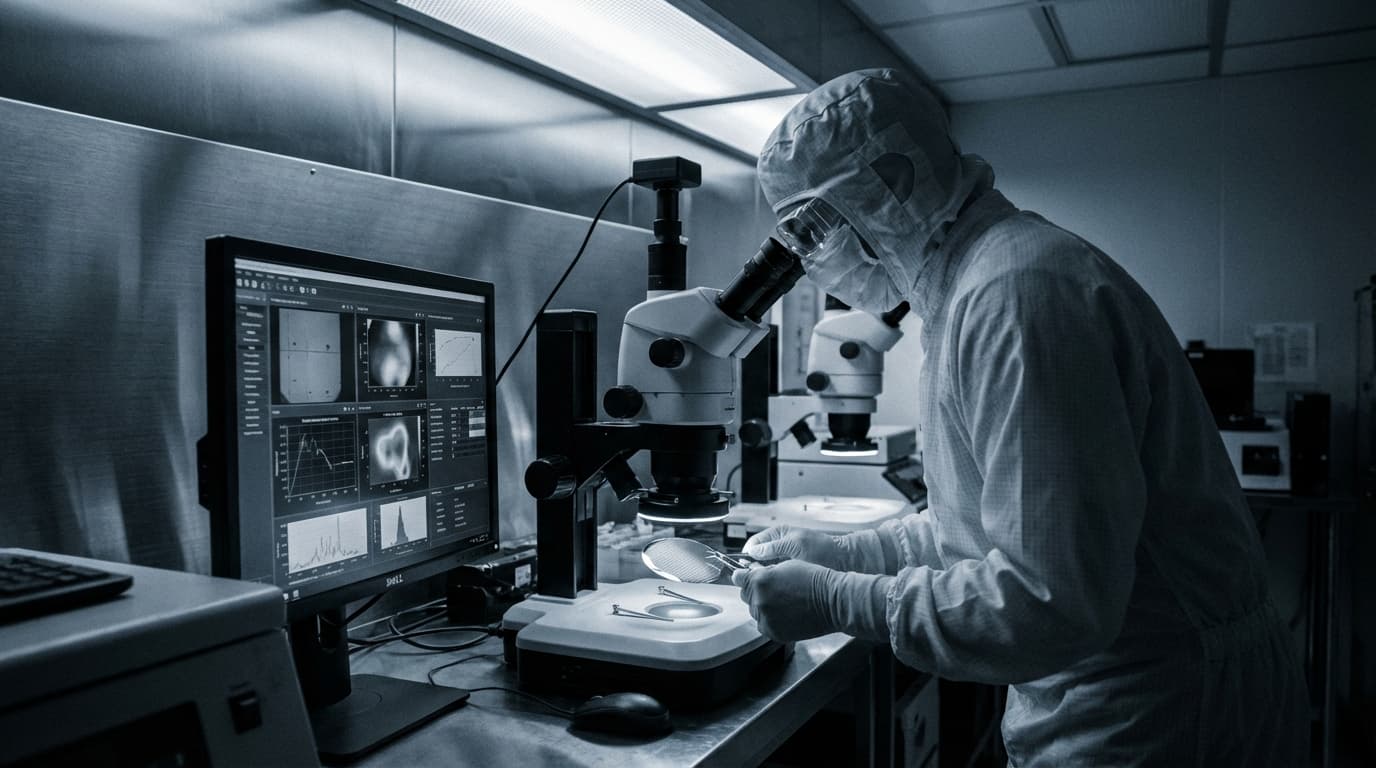
Semiconductor Manufacturing
·Asia-Pacific·12 monthsAI Quality Inspection for a Leading Semiconductor Manufacturer
Deployed AI-powered visual quality inspection on production lines for a leading semiconductor manufacturer, replacing manual inspection processes and outperforming a competing solution from a major Chinese AI vendor valued at over $40 billion. The system detects micro-defects invisible to human inspectors at full production line speed, reducing defect escape rates and improving yield.
Beat
$40B competitor in accuracy benchmarks
40%
Reduction in defect escape rate
Line speed
Real-time inline inspection
Challenge
Semiconductor manufacturing demands extreme quality tolerances. Defects measured in micrometres can render a chip non-functional, and the cost of a defective product reaching a customer — particularly in automotive and medical device applications — extends far beyond the unit cost to include recalls, liability, and reputational damage. This manufacturer operated multiple fabrication and assembly lines producing components for automotive, industrial, and consumer electronics applications, each with different quality specifications and defect classifications. Manual visual inspection was the primary quality gate. Trained inspectors examined components under microscopes, looking for surface defects, alignment errors, bond wire issues, encapsulation flaws, and contamination. Human inspection had fundamental limitations: inspector fatigue degraded accuracy over shifts, throughput was limited by the time each unit required under the microscope, and subjective judgment meant that borderline defects were classified inconsistently across inspectors. The manufacturer had attempted to address this with a solution from a major Chinese AI vendor, but found that its general-purpose computer vision models produced unacceptable false positive rates on the specific defect types relevant to their product lines. Beyond the production line, quality data was siloed. Defect information was recorded per line and per shift but not systematically analysed for patterns that might indicate process drift, equipment degradation, or material quality issues upstream. The quality team knew that correlating defect patterns with process parameters could enable predictive quality management, but extracting and analysing the data manually was impractical.
Approach
Reluvate developed custom computer vision models trained specifically on the manufacturer's product lines and defect types. Rather than using a general-purpose defect detection model, Reluvate captured thousands of images of known-good and known-defective components from each product line, training specialised models that understood the specific visual signatures of each defect category — die cracks, wire bond lift-off, solder bridging, encapsulation voids, lead frame oxidation, and die attach voiding. The models were optimised for the specific camera systems and lighting configurations on each production line. The inspection system operates inline — mounted at existing inspection stations on the production line — and processes components at full production speed. Each component is captured by high-resolution cameras at multiple angles, and the AI evaluates all images in milliseconds, classifying the component as pass, fail, or borderline. Borderline cases are diverted to a separate station for human review. The system provides defect location, type, and severity for every detected issue, enabling targeted rework rather than scrap for repairable defects. The quality analytics module aggregates inspection data across all production lines and correlates defect patterns with upstream process parameters — temperature profiles, pressure settings, material lot numbers, equipment maintenance history. This correlation analysis enables predictive quality management: when the system detects a statistical shift in a specific defect type, it traces the likely root cause through the process chain and alerts the process engineering team before the issue escalates to a yield-impacting event.
Design Notes
The critical design decision was training product-specific models rather than relying on transfer learning from general defect detection datasets. Semiconductor defects are visually subtle — a micro-crack may be only a few pixels wide in a high-resolution image — and the visual background (die patterns, wire layouts, substrate textures) varies significantly between product lines. General-purpose models treated product-line-specific visual patterns as potential defects, driving the high false positive rates that plagued the previous vendor's solution. Reluvate's product-specific training eliminated this class of false positives. Change management for the quality team required addressing a legitimate concern: that AI inspection would deskill the inspection workforce. Reluvate worked with the quality manager to redefine the inspector role. Instead of examining every component, inspectors now handle borderline cases flagged by the AI (requiring greater expertise, not less), perform calibration and validation of the AI system, and focus on root cause analysis when defect trends emerge. The new role requires deeper quality engineering knowledge, which the manufacturer supported with additional training. Exception handling covers scenarios where the AI encounters components that fall outside its training distribution — new product variants, unusual defect modes not seen before, camera or lighting degradation. The system monitors its own confidence distribution and alerts the quality team when the distribution shifts, indicating that something in the production environment has changed. Components inspected during low-confidence periods are quarantined for human review until the root cause is identified and the system is recalibrated.
Result
The AI inspection system outperformed the previous vendor's solution in benchmarks conducted by the manufacturer's quality team, achieving higher detection rates with significantly lower false positive rates. Defect escape rates dropped measurably, improving outgoing quality and reducing customer returns. Inspection throughput increased as the AI processed components at full line speed without the fatigue-related slowdowns inherent in human inspection. Predictive quality analytics enabled early detection of process drift, reducing the number of defective units produced before corrective action was taken.
Related Case Studies
Education
Award-Winning AI-Powered CAD Assessment for National Education
Developed an AI-powered automated assessment system for Computer-Aided Design (CAD) student submissions, replacing hours of manual instructor evaluation with instant, educational feedback. The system won the Ministry of Education (MOE) Innergy Award (Gold) — national recognition for innovation in education — and has been adopted internationally.
Retail & Conservation
Computer Vision Retail Analytics and Wildlife Monitoring
Developed computer vision systems for two distinct domains: retail analytics (footfall tracking, customer heatmaps, and employee activity monitoring across store networks) and animal welfare monitoring (behavioural analysis, temperature tracking, and health anomaly detection). The retail system outperformed a major Chinese AI competitor's solution in accuracy benchmarks.
Education Technology
AI-Powered Talent Management Platform for an EdTech Company
Built an AI-driven talent management platform that maps employee competencies against job requirements, generates personalised training roadmaps, and automates assessment through AI-generated questions and essay marking. The platform enables organisations to identify skill gaps, track development progress, and make data-driven decisions about talent deployment.