
Construction
·Singapore & Japan·11 monthsAI Safety Inspection and Project Management for a Construction Firm
Deployed AI-powered safety inspection and project management automation for a construction firm operating across Singapore and Japan. Computer vision models analyse site imagery to detect safety violations and hazard conditions, while project management agents automate progress tracking, resource scheduling, and regulatory compliance documentation for BCA and Japanese building authority requirements.
3x
Increase in safety violations detected
Minutes
Hazard response time (was hours)
2
Jurisdictions with automated compliance
Challenge
Construction sites are among the most hazardous work environments, and safety inspection is both critical and resource-intensive. This firm operated major projects in Singapore and Japan simultaneously, subject to BCA (Building and Construction Authority) regulations in Singapore and a separate set of Japanese building safety standards. Safety officers conducted daily site walks, visually inspecting for hazards — unsecured scaffolding, missing PPE, inadequate barricading, improper material storage, housekeeping violations — and documenting findings in paper-based or spreadsheet reports. The manual process was thorough but slow, subjective (different officers flagged different things), and provided only point-in-time snapshots rather than continuous monitoring. Project management was similarly manual. Progress tracking required site managers to estimate completion percentages for each work package, which were aggregated into project-level reports for the client and regulatory authorities. These estimates were subjective and often optimistic. Resource scheduling — coordinating subcontractors, equipment, material deliveries, and inspections — was managed through spreadsheets and WhatsApp groups. The coordination complexity grew exponentially as project phases overlapped and dependencies cascaded. Regulatory compliance documentation consumed significant project management time. BCA in Singapore requires extensive documentation — safety management plans, risk assessments, incident reports, inspection records, and periodic statutory submissions. Japanese requirements added another layer. Both jurisdictions demanded meticulous record-keeping, and any gaps in documentation during an audit could result in stop-work orders, fines, or prosecution.
Approach
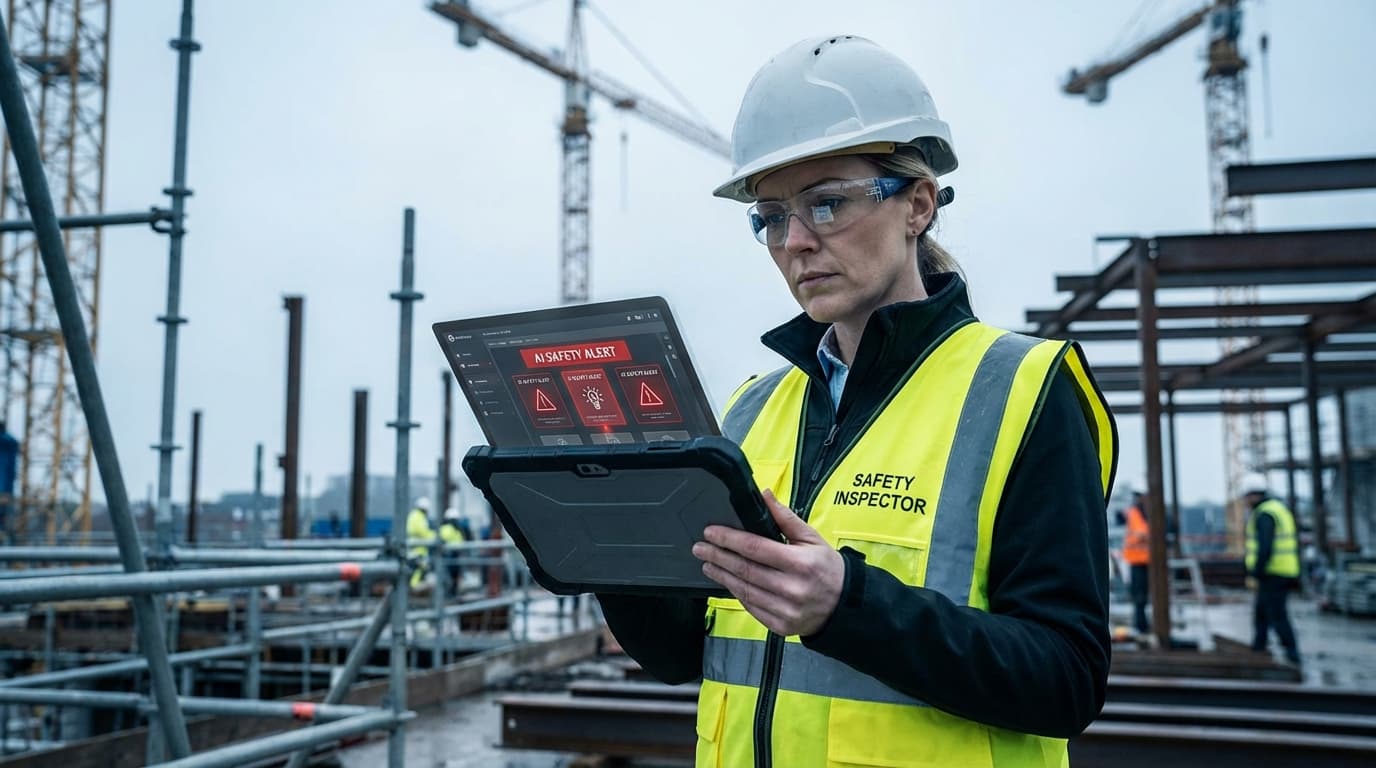
Reluvate deployed a dual system: computer vision for safety monitoring and AI agents for project management. The safety monitoring module processes imagery from fixed site cameras, drone surveys, and mobile devices carried by safety officers. Computer vision models trained on construction-specific datasets detect safety violations in real-time: workers without PPE (hard hats, safety vests, harnesses), unsecured scaffolding, inadequate barricading around excavations, improper material stacking, and housekeeping hazards. Detected violations generate immediate alerts to the site safety officer with annotated images showing the violation location and type. The project management module automates progress tracking by integrating with the firm's project scheduling software (Primavera P6) and augmenting scheduled milestones with actual progress data from site imagery analysis, delivery receipts, and inspection records. AI agents compare planned progress against actual, flag schedule variances early, and recommend recovery actions when delays are detected. Resource scheduling is optimised by balancing subcontractor availability, equipment requirements, material delivery windows, and inspection schedules. Compliance documentation is automated through template-based generation. The system maintains a continuous record of safety inspections (both AI-detected and human-conducted), generates statutory reports in BCA and Japanese formats, tracks regulatory submission deadlines, and maintains the audit trail required for regulatory compliance. Incident reporting is streamlined through a mobile interface where site staff can report incidents that are automatically categorised, documented, and routed to the appropriate investigation workflow.
Design Notes
The computer vision models were trained specifically for the visual complexity of construction sites, which is significantly more challenging than controlled manufacturing environments. Construction sites have variable lighting (outdoor, changing weather), cluttered backgrounds (equipment, materials, structures in progress), partial occlusion (workers behind scaffolding, equipment blocking sightlines), and diverse PPE requirements that vary by work activity and zone. Reluvate built a staged detection pipeline: first identifying people, then assessing their PPE and activities, then evaluating their context (are they in a zone requiring fall protection?) to determine if a violation exists. Change management for safety officers was straightforward — the system augmented rather than replaced their role. Safety officers welcomed the continuous monitoring capability because it addressed their biggest frustration: they could only be in one place at a time, and violations occurring when they weren't present went undetected. The AI provides the always-on monitoring that safety officers knew was needed but couldn't achieve alone. Exception handling in construction must account for legitimate deviations from standard safety rules. Certain work activities temporarily require modified safety protocols — hot work permits, confined space entries, crane lift plans. The system maintains a permit registry and adjusts its violation detection thresholds based on active permits. A worker without a hard hat in an active crane zone is a critical violation; a worker without a hard hat in a demarcated hot work zone with an active hot work permit and appropriate alternative PPE may be compliant.
Result
Safety violation detection rates increased significantly as AI monitoring supplemented human inspections with continuous coverage. Response time to hazardous conditions dropped from hours (until the next safety walk) to minutes (real-time alert). Project schedule adherence improved as early variance detection enabled proactive corrective action rather than reactive crisis management. Regulatory compliance documentation went from a burden to a by-product — generated automatically from the system's continuous monitoring and record-keeping.
Related Case Studies
Education
Award-Winning AI-Powered CAD Assessment for National Education
Developed an AI-powered automated assessment system for Computer-Aided Design (CAD) student submissions, replacing hours of manual instructor evaluation with instant, educational feedback. The system won the Ministry of Education (MOE) Innergy Award (Gold) — national recognition for innovation in education — and has been adopted internationally.
Retail & Conservation
Computer Vision Retail Analytics and Wildlife Monitoring
Developed computer vision systems for two distinct domains: retail analytics (footfall tracking, customer heatmaps, and employee activity monitoring across store networks) and animal welfare monitoring (behavioural analysis, temperature tracking, and health anomaly detection). The retail system outperformed a major Chinese AI competitor's solution in accuracy benchmarks.
Education Technology
AI-Powered Talent Management Platform for an EdTech Company
Built an AI-driven talent management platform that maps employee competencies against job requirements, generates personalised training roadmaps, and automates assessment through AI-generated questions and essay marking. The platform enables organisations to identify skill gaps, track development progress, and make data-driven decisions about talent deployment.