
Facilities Management
·Singapore·8 monthsAI Tree Hazard Detection for Urban Facilities Management
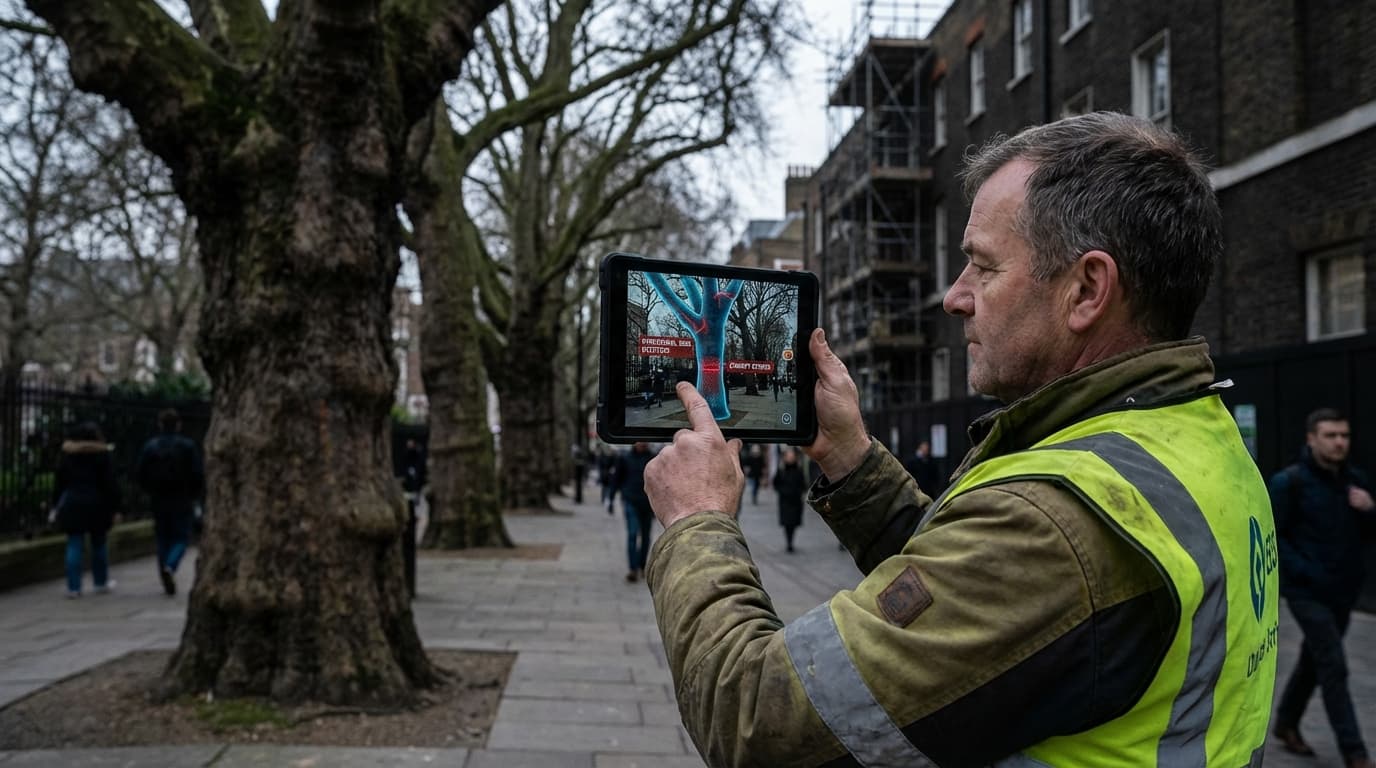
Developed a computer vision system that analyses aerial and ground-level imagery to identify trees vulnerable to storm damage in urban environments. The system assesses tree health indicators, structural risk factors, and proximity to infrastructure, generating prioritised risk maps that enable proactive tree management before storm events — replacing reactive post-storm cleanup with preventive intervention.
Thousands
Trees screened per day (was dozens)
Proactive
Pre-storm intervention capability
Risk-ranked
Prioritised management across estates
Challenge
Urban tree management in tropical climates is a safety and infrastructure protection challenge. Singapore's dense urban canopy — millions of trees along roads, in parks, and within building compounds — is exposed to frequent severe weather including monsoon storms and thunderstorms. Fallen trees cause injuries, block roads, damage vehicles and buildings, disrupt power lines, and generate costly emergency response operations. The traditional approach was reactive: wait for a storm, then deploy crews to clear fallen trees and repair damage. Proactive tree inspection existed but was severely resource-constrained. Certified arborists performed visual inspections of trees on a rotating schedule, assessing health indicators (crown dieback, fungal infection, bark damage), structural factors (lean angle, root plate condition, branch attachment strength), and proximity to critical infrastructure (power lines, buildings, pedestrian areas). But with millions of trees and limited arborist capacity, the inspection cycle was too long — a tree could develop a critical defect and encounter a major storm before its next scheduled inspection. The facilities management organisations responsible for tree maintenance — town councils, property management companies, government agencies — needed a way to screen the entire tree population between inspection cycles, identifying the highest-risk trees for prioritised arborist attention. Manual screening of aerial imagery was possible but too labour-intensive to be practical at scale.
Approach
Reluvate developed a computer vision pipeline that processes both aerial imagery (drone surveys, satellite imagery) and ground-level photographs to assess tree risk. The aerial imagery analysis identifies individual trees, estimates their canopy size and density, detects visible health indicators (crown thinning, discolouration, dead branches), and measures lean angle relative to vertical. The ground-level analysis — conducted from vehicle-mounted cameras during routine patrols — captures additional risk factors: trunk condition, root plate exposure, structural defects visible at ground level, and proximity to infrastructure. The risk assessment model combines visual indicators with contextual data — tree species (some species are more prone to failure), soil type, drainage conditions, exposure to prevailing wind direction, and historical failure records for similar trees in similar conditions. Each tree receives a risk score that represents the probability of failure in a significant weather event multiplied by the consequence of failure (based on proximity to people and infrastructure). Risk maps are generated at estate, district, and city levels, enabling facilities managers to prioritise inspection and maintenance resources. Pre-storm planning is a key use case. When severe weather is forecast, the system generates a prioritised intervention list — trees with the highest risk-consequence scores in the forecast affected area. Facilities management teams can dispatch crews for preventive pruning or bracing of the highest-risk trees before the storm arrives, converting reactive emergency response into planned preventive maintenance.
Design Notes
The tree detection and segmentation models were trained on Singapore-specific urban imagery, which presents unique challenges: tropical tree species have different visual characteristics from temperate species used in most published datasets, urban trees are often partially occluded by buildings and infrastructure, and the high density of Singapore's streetscape means trees are often closely spaced or interleaved. Reluvate collected and annotated a Singapore-specific training dataset in partnership with arborists who provided ground-truth health assessments for training samples. Change management addressed the relationship between AI screening and professional arborist assessment. The system was explicitly not positioned as a replacement for arborist inspection — it is a screening tool that identifies which trees most urgently need professional attention. Arborists welcomed the system because it solved their core frustration: too many trees to inspect and no way to prioritise other than scheduled rotation. AI screening directs their expertise where it matters most. Exception handling accounts for the limitations of visual assessment. Some tree defects — internal decay, root disease, structural weakness at branch junctions — are not visible from external imagery. The system flags trees where the visual assessment is inconclusive (e.g., a tree with a high lean angle but otherwise healthy canopy) and recommends advanced assessment methods (resistograph testing, root radar, climber inspection) for these cases. Trees adjacent to high-consequence targets (schools, hospitals, MRT stations) receive automatic priority elevation regardless of their assessed condition.
Result
The system enables population-level tree risk screening that was previously impossible, processing thousands of trees per day compared to the dozens that a manual arborist inspection team could cover. Proactive intervention before storm events has been demonstrated to reduce storm damage incidents in managed estates. Facilities management organisations report improved resource allocation — arborist time is directed to the highest-risk trees rather than following a rotating schedule. The system has been adopted by multiple town councils and property management companies as part of their preventive maintenance programmes.
Related Case Studies
Education
Award-Winning AI-Powered CAD Assessment for National Education
Developed an AI-powered automated assessment system for Computer-Aided Design (CAD) student submissions, replacing hours of manual instructor evaluation with instant, educational feedback. The system won the Ministry of Education (MOE) Innergy Award (Gold) — national recognition for innovation in education — and has been adopted internationally.
Retail & Conservation
Computer Vision Retail Analytics and Wildlife Monitoring
Developed computer vision systems for two distinct domains: retail analytics (footfall tracking, customer heatmaps, and employee activity monitoring across store networks) and animal welfare monitoring (behavioural analysis, temperature tracking, and health anomaly detection). The retail system outperformed a major Chinese AI competitor's solution in accuracy benchmarks.
Education Technology
AI-Powered Talent Management Platform for an EdTech Company
Built an AI-driven talent management platform that maps employee competencies against job requirements, generates personalised training roadmaps, and automates assessment through AI-generated questions and essay marking. The platform enables organisations to identify skill gaps, track development progress, and make data-driven decisions about talent deployment.